
From the Playground to the Playroom: How We Turn Our Old Wounds Into Healing Tools
6/18/20263 min read
We often talk about kink as if it exists in a vacuum—a detached, quirky preference that just magicaly appears in our adult brains. But if we are being completely honest, our desires rarely arrive out of nowhere. More often than not, they cut right to the core of how we try to heal, express, or sometimes replicate our earliest relational patterns.
Take my own journey, for example.
I know for a fact that my kink for female domination is intrinsically linked to the bullying I endured back in school. For a long time, school was an unpredictable minefield of degradation and pain. But in the intentional space of BDSM, I’ve found a way to flip the script. I find it incredibly helpful to go deep into that familiar degradation and exploration of pain—but this time, it's on my own terms.
Crucially, the scene doesn't end where the schoolyard did. It moves into intentional aftercare and a role-reversal where I am reminded that people are fundamentally good.
If we look at this through the lens of psychological development and attachment theory, you can absolutely see how someone could arrive at that conclusion. At the same time, contemporary psychology and sexology often view it from a completely different angle: as a highly functional, conscious mechanism for meeting those exact same needs.
Let’s break down both perspectives to see how the wound and the weapon can coexist.
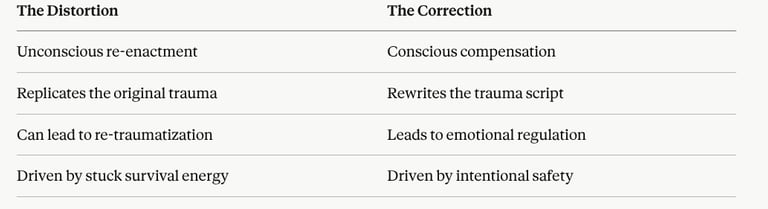
Perspective 1: The Distortion (Re-Enacting the Wound)
This intuition aligns closely with psychodynamic and trauma-informed perspectives (similar to theories explored by thinkers like Terry Real or Gabor Maté), which suggest that adult compulsions and intense desires are often echoes of childhood adaptation. From this viewpoint, BDSM can sometimes act as a distortion, or a "survival strategy" masquerading as a preference.
The Need for Boundaries and Limits: If a person grew up in an environment where their boundaries were constantly violated, or conversely, where there was zero containment (neglect and chaos), they never learned what healthy, safe limits felt like. In adulthood, the psyche might seek out extreme, rigid physical boundaries (like literal bonds or strict rules) because standard, subtle relational boundaries feel invisible or unsafe.
The Need for Guidance vs. Control: A deep hunger for guidance or paternal/maternal protection can be distorted into a desire for total submission or dominance. Instead of developing internal agency or finding a mutually supportive peer relationship, the individual externalizes the control, giving up their agency to feel "safe" from the burden of their own anxiety.
When It Becomes Ineffective: It becomes a distortion when it acts purely as a re-enacting mechanism. If a person is unconsciously recreating a dynamic of powerlessness or pain hoping for a different outcome, but ends up just re-traumatizing themselves without achieving true emotional integration or safety, the loop remains unbroken.
Perspective 2: The Correction (Conscious Compensation)
Conversely, modern research into the psychology of BDSM often views it not as a pathology, but as a form of therapeutic compensation—a highly efficient, somatic (body-based) tool to process deep attachment needs. For many practitioners, it provides a hyper-intentional space to experience the things they lacked, but under conditions of absolute safety.
Flawless Consent and Boundaries: In typical relationships, boundaries are often murky, unsaid, and easily breached. In a BDSM context, boundaries are explicit, negotiated in advance, and heavily enforced by safe words. For someone with an insecure attachment style, this hyper-clarity is incredibly liberating. It allows them to experience vulnerability without the terrifying ambiguity of everyday relational politics.
Satiating the Need for "Containment": In attachment theory, a child needs to feel "contained" by an adult's calm, strong presence. For a submissive, being physically or psychologically contained by a dominant can trigger a profound neurological release. It allows a hyper-vigilant nervous system to finally shut down and rest, knowing someone else is completely in charge of the environment.
Re-Writing the Script: Unlike childhood trauma, where pain or control was unpredictable and non-consensual, BDSM allows adults to play out high-stakes dynamics where they hold the ultimate control. This is a powerful way to move through stuck survival energy (fight, flight, or freeze) and emerge on the other side feeling seen, held, and cared for during the aftercare phase.
The Two Lenses of BDSM
The Differentiating Factor: Consciousness and Integration
Whether BDSM functions as a distortion or a healing tool usually comes down to one thing: awareness.
If it is driven by a compulsive, unconscious urge to repeat a painful past, it often leaves the person feeling empty, confused, or further disconnected from genuine intimacy. But if it is approached with deep self-awareness, clear communication, and an understanding of one's own emotional landscape, it becomes something beautiful. It becomes a highly organized, effective laboratory for experiencing boundaries, surrender, and deep relational trust.
Ultimately, it is entirely possible for it to be a distortion for one person and a profound source of regulation for another. And as many of us know from our own journeys, it can often be a complex, beautiful mix of both for the very same individual.
How has your own past shaped the spaces where you feel safest exploring vulnerability today?
If you'd like some help with this, I offer one-to-one coaching or come to one of my group workshops where we prioritize aftercare, safety, and connection.


Playful Desires
Embrace the innocence of your Playful Desires in a fun, safe and beautiful space for play.
© 2025. All rights reserved.